INFLUENCE
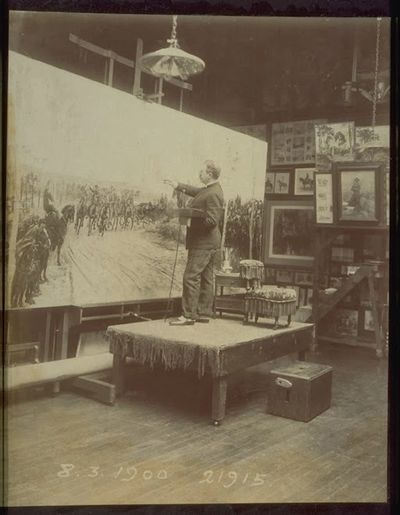
Jean Baptiste Edouard Detaille
The historical arc of French painting from the mid-nineteenth through the early twentieth century reveals a fascinating paradox where radical rebellion ultimately curdled into institutional complacency. It began with the liberation of plein air painting, a movement championed by the Barbizon School and later exploded by the Impressionists who shattered the dark, studio-bound conventions of the academy to capture shifting natural light and everyday modern life outdoors. Yet, operating parallel to this avant-garde struggle were titans of official academic precision like Jean-Louis-Ernest Meissonier and his student Jean-Baptiste-Édouard Detaille. Meissonier achieved staggering wealth and fame through microscopic historical exactitude, while Detaille became the undisputed master of monumental, hyper-realistic military panoramas that fed the patriotic appetite of the French bourgeoisie. As the decades rolled into the opulent Belle Époque, the monumental glass-and-steel nave of the Grand Palais, constructed for the 1900 Exposition Universelle, emerged as the ultimate grand temple for this academic and commercial establishment, hosting the official Salons where high-status art was bought, sold, and validated by the state. The ultimate irony of art history struck when the Impressionists, originally despised outcasts, finally achieved widespread public acceptance, financial triumph, and institutional embrace. Once their once-subversive techniques of light and brushwork became the safe, commercially lucrative standard of the wealthy elite displayed beneath the cavernous vaults of the Grand Palais, they risked morphing into a new iteration of art pompier. This term, historically hurled at the pompous, theatrical, and rigidly conventional history paintings of the state academy, captures the inevitable fate of artistic revolutions that conquer the market: the radical spark goes out, replaced by the self-satisfied comfort of establishment success.
The monumental canvas size of Jean-Baptiste-Édouard Detaille's famous masterwork Le Rêve (The Dream), housed in the Musée d'Orsay in Paris, measures an impressive 300 cm by 400 cm (approximately 9.8 ft × 13.1 ft). Painted in 1888, this epic oil painting depicts an encampment of French soldiers sleeping on the ground during military maneuvers, their dreams projecting an ethereal, massive vision of past French military glories and regiments fading into the clouds above them. Beyond this centerpiece, collections at institutions like the Musée de l'Armée preserve many of his other military studies, smaller precise works, and artifacts reflecting his deep immersion in the architecture of military campaigns. Detaille was also renowned for massive collective or panoramic undertakings—such as his joint works on colossal cycloramas that immersed spectators entirely within grand historical battle settings.
Carrying Edouard Detaille “grand formats” forward into contemporary spectacle is Jean-François Detaille (often billed professionally for his high-impact live performances). Adapting the monumental scale and theatrical ambition of Édouard’s historical canvases into a modern-day medium, Jean-François pioneered "Extreme Art." Instead of traditional studio painting, his practice involves creating giant, large-scale canvases live on stage in front of audiences as a form of high-energy performance art. Working at a breakneck pace on massive proportions, he translates the legacy of nineteenth-century French academic monumentalism into a dynamic, time-sensitive spectacle for corporate events, galas, and global audiences—bridging the gap between the historical giant canvas tradition of the Belle Époque and modern performance entertainment.
My early days exposure to art
Salvador Dali
Salvador Dali
Salvador Dali

Salvador Dalí and flamenco guitarist Manitas de Plata performed and created live art together in 1965.
JUDO TO ART
Salvador Dali
Salvador Dali
Yves Klein as myself was a judoka and I had the same need to bring power into my canvas.
PEPE MARTINEZ LOZANO
My dad friend
MY FIRST DARING
MY FIRST DARING
My dad an I used to go see Pepe paint watercolors at the port of Llanca in Catalonia, he was all a show, dipping his cigar in his cognac glass and smoking a big cigar, creating wet in wet amazing powerful art, than with the proceed of a good day sale he would go to the restaurant were we were dining. And paid a round to everyone in the place. He was always telling me: “life is a comedy”
MY FIRST DARING
MY FIRST DARING
MY FIRST DARING
ART IS ABOUT BREAKING THE RULES
My art teacher Marcel Warrant asked me to paint a shoe in my own way, I ask him:, one or two shoes… than I walked outside in the dirt, took paint on my fingers than went for it! 1977